
Want best impact? Change yourself!
A lot of us want to create an impact, especially the ones that comes in B-I-G font size. Change the world. Stop global warming. Establish world peace. Find cancer cure. Stop wars. Leave a legacy that lasts forever. We want to conquer the world with our ideas, our creation, our accomplishments....
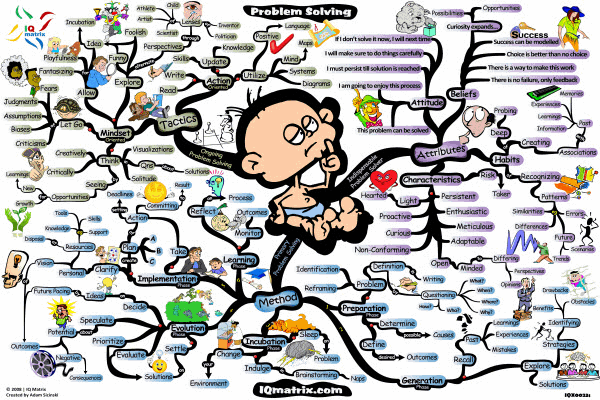
Are you thinking about solving the problem, or simply fixing it?
What is the first thing that comes to mind when we see the problem? Most of us immediately jump in to start solving it. While this might appear to be a natural instinct and a logical choice for some simple problems, reality could often be otherwise, especially for complex problems. If we don’t know enough about genesis of that problem, we might spend countless hours fixing it, and yet hardly make any meaningful headway. Or, we might fix it in the short-term, but might not solve it in the long-run, i.e. address the root-cause behind it. For all we know, the first thing we do might actually be the worst!...

How to establish credibility in a democratic workplace?
Flattening of organizations is an oft-repeated phrase that means different things to different people. My favorite connotation is what I call as ‘democratization of management’, which essentially means a more symmetric power distribution between erstwhile ‘management’ and the erstwhile ‘worker’- if at all such words make sense anymore. While there are serious advantages of such an organization structure, it obviously doesn’t come free of cost. For example, a key byproduct of such change is moving away from ‘leading with authority’ to ‘leading with influence’ where leaders can’t rely on their positional power or the organizational title to basically get things done. Instead, they need to establish their ‘credibility’ to be accepted as a ‘leader’ and the harbinger of change, and get things done. Sounds simple? Well, it may not be so easy… In the old world where management unilaterally...
Ten Commandments for Revolutionary Change Agents
Revolutionaries are a restless lot. In a way, they are like the ‘shooting stars’ in an organization - they are seriously outnumbered by the hundreds of twinkle-twinkle little stars, they enter an organization with tails-on-fire hurry, and (try to) change everyone and everything around them within the short time span that they are there, and then they burn out (or just lose interest when the work they set out for is either accomplished, or get bored when it doesn’t get accomplished) and just move on. They don’t have a lot of time, patience or socialistic motives making small changes here and there, or to make elaborate plans and do surveys, investigations and pilots, and so on. They would rather be out there in the middle of heat, dust and all the adrenalin-pumping and chest-thumping action than be found napping in a...
Change yourself, not the mirror
Change is painful, especially when you have to change yourself. However, in reality all change is really about - changing yourself ! When people ignore this simple and timeless truth, they start accumulating a lot of ‘rigidity’ - growing at the rate of one day at a time, until that years-of-accumulated-and-hardened-behavior becomes a Frankenstein’s monster and an inseparable and indistinguishable part of themselves ! So much so, that they don’t even see that as the problem. I read somewhere that it takes an average of 21 days for a practice to become habit. I think the same must be true for negative change - i.e., refusal to adapt to changes around us. And in, perhaps, as little as 21 days, we just fortify ourselves against the impending and growing change around us. When that happens, another fantastic thing happens....
Do you know your Zenobia(s) ?
Zeonbia is a great book by Matthew Emmens and Beth Kephart that you can not only complete in under an hour, you probably want to read it once again right away - to get a better flavor of the simple yet powerful story of Moira who must find a way out of the chaos she encounters day one of her job and no one is quite willing to help her. Zenobia is story of our times which is such a hard-hitting truth. I would say Moira is lucky (or rather willing to challenge status quo ?) in the sense she is able to see that there is a problem - a majority of us do not evey realize there is a problem at the workplace. Of course, of those sharp minds who are able to figure out there is indeed...