
Building Credibility in Four Easy Steps
In the new flat world, power is mostly displaced by "credibility." It is not enough to be a senior anymore to bring about changes or make key decisions - if you don't have the credibility, people are likely to reject your ideas. And given the nature of roles in today's workplace, roles don't guarantee credibility. One must work hard to build it.

Can Program Managers Make it to the Executive Suite?
I recently shared some view on this subject for PMI's Career Central article by the same name. In this post, I have shared the original article.
Effective Escalation Practices
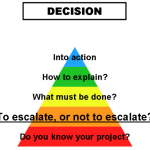
Great leaders know how to focus on project management competencies. Perhaps nowhere in project management do effective soft skills shine through more than in the process of escalation and escalation mitigation. Knowing when and how to escalate requires more than just an intimate knowledge of the emerging issue, but a deeper understanding of the entire business landscape surrounding the events that have led you to this moment.

How to establish credibility in a democratic workplace?
Flattening of organizations is an oft-repeated phrase that means different things to different people. My favorite connotation is what I call as ‘democratization of management’, which essentially means a more symmetric power distribution between erstwhile ‘management’ and the erstwhile ‘worker’- if at all such words make sense anymore. While there are serious advantages of such an organization structure, it obviously doesn’t come free of cost. For example, a key byproduct of such change is moving away from ‘leading with authority’ to ‘leading with influence’ where leaders can’t rely on their positional power or the organizational title to basically get things done. Instead, they need to establish their ‘credibility’ to be accepted as a ‘leader’ and the harbinger of change, and get things done. Sounds simple? Well, it may not be so easy… In the old world where management unilaterally...

Role of Integrative Thinking in Project Management
The conventional wisdom is to try to find a via media but that is perhaps meekly surrendering to complexity by taking a short-cut to a suboptimal solution. He argues that the some of the most exceptional leaders do not succumb to the obvious “either/or” thinking but rather work patiently towards synthesizing the best from both of these opposing views to create a best-of-breed solution that is far superior to either of these. He calls it “integrative thinking”.
How does manager’s proximity to team affects team dynamics and decision-making?
Congratulations! You’ve got the long-cherished promotion that will make you manager - of your own buddies! You don’t quite know what it means for your relations with the team - are you better-off as their manager or as their buddy? One key challenge with first-line managers, especially those fairly new in their roles, is how to strike right balance between formal reporting relationship and informal personal relations with the team. Considering that most people “leave managers and not companies”, this seems to be a critical issue, but seldom discussed. In my career, I have also seen similar issues when people became a second-line manager or a group manager for the first-time - so, this is not a one-time issue. I have often seen managers who have been promoted from within going all too out to please the team that...
How Mentoring can help Leaders too?
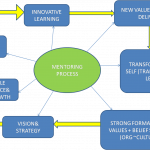
Last month, I sat through an interesting talk by two very senior business professionals, Ajit Chakravarti and Govind Mirchandani. The talk was organized by the Indo-American Chamber of Commerce (IACC), and you can read speaker profiles here. I found their talk particularly interesting because they did not talk any theory, and did not use any complex jargon or bulky models to explain their ideas. They talked about how and why leadership also requires to be mentored, and how a mentor makes the difference. They used the analogy of Krishna as a mentor to Arjun in the Kurushetra battlefield. Arjun is torn by the value conflict - should he fight and kill his own kith and kin for the sake of getting his kingdom back? He doesn’t require training for the war, nor does he require any coaching for the battle - the fact that he is...
Why do you Innovate ?
Last week, NASSCOM organized a talk on innovation by Rob Shelton, co-author of “Making Innovation Work“, followed by excellent presentations by two of the previous year’s winner of NASSCOM Innovation awards, Intel India and Sloka Telecom. It was good learning to sit in Rob’s audience and listen to his perspectives on innovation. I liked his (probably) favorite punchline (because he must have repeated it couple of times during his presentation): “How you innovate determines why you innovate“. I think this is a great way to sum up if an organization is undertaking innovation as a strategic differentiator or just to play catch-up on a tactical level. In his view, the three building blocks of innovation are leadership, culture and process. His perspective is that innovation originates from business strategy could be either a technology innovation or a business model...
Top 3 reasons why you should encourage social networking at workplace
Yesterday, I had the wonderful opportunity to be invited to a CEO Roundtable breakfast meeting organized by EMC at IIM Bangalore. The topic of discussion was how relevant is social networking for organizations, and what are some of the organizations doing about it. The session was led by Jack Mollen, EMC’s EVP for Human Resources. It was nice to learn how large organizations like EMC were leveraging the power of social networking. He informed that EMC with some 45,000 employees has some 20,000 virtual communities ! Wow, that must be a cool way to get all people connected from any place within the company to any other place. Partha from Mindtree highly recommended reading about EMC’s social networking platform, and also informed that they have been experimenting with social networks for the last seven years now. I shared some of...
Addressing the issue of “social loafing” in large teams
 Large teams might be inevitable in certain large endeavors, but there are several benefits of small teams. A small team can build and maintain a strong culture and a character that gets better with time. Small teams quickly learn the invaluable skills in teamwork and interdependence that lead to higher efficiencies while ensuring that individual team members don’t end up competing against each other but rather collaborate on the common objectives. Small teams also mean small egos One of the biggest motivations of making smaller teams is to provide higher levels of transparency and task accountability to individual team members. A large team tends to hide inefficiencies, both of its structure and of its people. One particular problem in a large team is the problem of “social loafing” - something that is perhaps best described in this poem by Charles...