
What 16months of stay at Antarctica taught me?
It's been twenty years since I went to the magnificent seventh continent (which, ironically, became the first continent that I visited, apart from Asia, where I was born and grew up). I just have to close my eye for a few seconds, and I am still able to teleport myself back to majestic and pristine Antarctica, and the Indian station Maitriwhich was my home for 16 months during 1993-95....
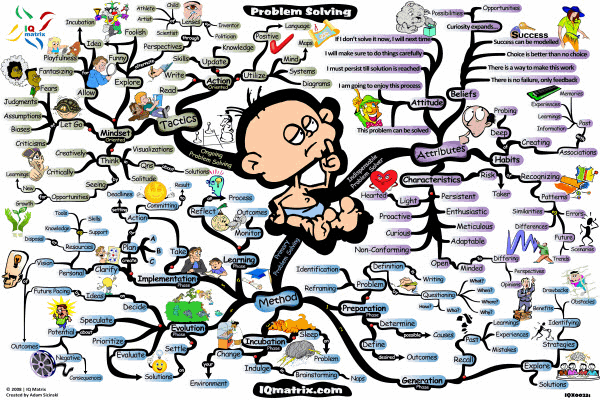
Are you thinking about solving the problem, or simply fixing it?
What is the first thing that comes to mind when we see the problem? Most of us immediately jump in to start solving it. While this might appear to be a natural instinct and a logical choice for some simple problems, reality could often be otherwise, especially for complex problems. If we don’t know enough about genesis of that problem, we might spend countless hours fixing it, and yet hardly make any meaningful headway. Or, we might fix it in the short-term, but might not solve it in the long-run, i.e. address the root-cause behind it. For all we know, the first thing we do might actually be the worst!...

Effective Escalation Practices
Great leaders know how to focus on project management competencies. Perhaps nowhere in project management do effective soft skills shine through more than in the process of escalation and escalation mitigation. Knowing when and how to escalate requires more than just an intimate knowledge of the emerging issue, but a deeper understanding of the entire business landscape surrounding the events that have led you to this moment....

Is your project’s team spirit ‘flammable’?
Welcome to the ‘day-mare’ of leading a dysfunctional team with highly ‘flammable’ spirit – nothing is perhaps more detrimental to project success than such team dynamics. Assembling a crack team doesn’t automatically transform into a dream team. ...

How does manager’s proximity to team affects team dynamics and decision-making?
Congratulations! You’ve got the long-cherished promotion that will make you manager - of your own buddies! You don’t quite know what it means for your relations with the team - are you better-off as their manager or as their buddy? One key challenge with first-line managers, especially those fairly new in their roles, is how to strike right balance between formal reporting relationship and informal personal relations with the team. Considering that most people “leave managers and not companies”, this seems to be a critical issue, but seldom discussed. In my career, I have also seen similar issues when people became a second-line manager or a group manager for the first-time - so, this is not a one-time issue. I have often seen managers who have been promoted from within going all too out to please the team that...

How Mentoring can help Leaders too?
Last month, I sat through an interesting talk by two very senior business professionals, Ajit Chakravarti and Govind Mirchandani. The talk was organized by the Indo-American Chamber of Commerce (IACC), and you can read speaker profiles here. I found their talk particularly interesting because they did not talk any theory, and did not use any complex jargon or bulky models to explain their ideas. They talked about how and why leadership also requires to be mentored, and how a mentor makes the difference. They used the analogy of Krishna as a mentor to Arjun in the Kurushetra battlefield. Arjun is torn by the value conflict - should he fight and kill his own kith and kin for the sake of getting his kingdom back? He doesn’t require training for the war, nor does he require any coaching for the battle - the fact that he is...
Why do you Innovate ?
Last week, NASSCOM organized a talk on innovation by Rob Shelton, co-author of “Making Innovation Work“, followed by excellent presentations by two of the previous year’s winner of NASSCOM Innovation awards, Intel India and Sloka Telecom. It was good learning to sit in Rob’s audience and listen to his perspectives on innovation. I liked his (probably) favorite punchline (because he must have repeated it couple of times during his presentation): “How you innovate determines why you innovate“. I think this is a great way to sum up if an organization is undertaking innovation as a strategic differentiator or just to play catch-up on a tactical level. In his view, the three building blocks of innovation are leadership, culture and process. His perspective is that innovation originates from business strategy could be either a technology innovation or a business model...
Shu-Ha-Ri and Situational Leadership for Managers
In the previous blogs What is the leadership style in your software teams ? and Situational Leadership in Software teams, I explored how leadership has evolved over time, and how we could relate it to the concept of situational leadership in the context of software development teams. Those thoughts were from an essentially western perspective where the ideas such as democracy in life and at work, free thinking, equality, participatory management, individualism (followed by a re-discovery of team-oriented approach to managing work) and shared leadership have been uniformally accepted in the social values and ably institutionalized by legislation. The net result is that we are seeing a great shift in the balance of power from the so-called ‘management’ (a.k.a. the role in an organization responsible to get the job done) to the so-called ‘labor’ (a.k.a. the role in an organization responsible to...

Situational Leadership in Software teams
In a previous post, What is the leadership style in your software teams ?, I discussed about four key types of leadership and their evoluation, and how it could possibly relate to software teams. In this blog post, let’s dwell on this topic further, and explore how to decide what leadership style suits a given situation. The assumption here is that there is no such thing as an “all-weather” or a personal favorite leadership style - each tool and method has pros and cons depending on why, how, when, what and where they are applied. The value one derives depends on how well a given style ‘fits’ the context - to that end, it it highly imperative to identify the ground conditions and only then decide what could work here more effectively. Our industry has a difficulty articulating with...
What is the leadership style in your software teams ?
Do you like to believe that the so-called ‘command and control’ is an exceptionally distasteful idea for intellctual work such as software development? I don’t particularly disagree with you, but just wondering - have you ever worked for a stereotypical ‘command and control organization’ in software industry, where things were forcibly thrust down your throat without taking your views, or you not having any freedom to question or disagree? We all seem to have romantic ideas and idealistic opinions about what it means (rather, what it should mean) but let’s ‘inspect and adapt’ our understanding with the real-world experiences so that we have a correct understanding of an incorrect idea.  In my close to two decades of working with European, Chinese (yes - contrary to what most people believe, Chinese also disagree with their managers very passionately just like anyone else,...