
Is your talent adorning the restroom?
On my recent visit to a wonderful new luxury hotel in town, I found it very interesting that an artist's work was commissioned right outside the restroom.
It seemed, at least to me, that the only reason that painter, or rather her talent, was of any particular importance to the hotel designers was if she could paint something that fitted the small wall that welcomed people to the restroom....

Hard work is killing people. Literally!
Burnout is a serious issue for several countries, industries and people, even if we don't acknowledge in as many words. In our industry, where heroism, cowboy programming and all-nighters are considered cool and an integral part of the software subculture, there has been a (really) small effort to address work-life balance....

Time to throw away your Talent Pyramid
Ask any HR Manager on talent profile for their organization and you will get a ‘talent pyramid’ – an odd-looking ‘pyramid’ that is supposed to reflect the talent profile of the organization. Ask them further – what is the measure of ‘talent’ in this pyramid, and chances are 9 on 10 that the answer will be ‘experience’. This experience is typically the number of years of (supposedly relevant) experience in the workforce, and pretty much determines how roles, and consequently the compensation are derived out of it. Question is – is that the right measure of talent?...

How does manager’s proximity to team affects team dynamics and decision-making?
Congratulations! You’ve got the long-cherished promotion that will make you manager - of your own buddies! You don’t quite know what it means for your relations with the team - are you better-off as their manager or as their buddy? One key challenge with first-line managers, especially those fairly new in their roles, is how to strike right balance between formal reporting relationship and informal personal relations with the team. Considering that most people “leave managers and not companies”, this seems to be a critical issue, but seldom discussed. In my career, I have also seen similar issues when people became a second-line manager or a group manager for the first-time - so, this is not a one-time issue. I have often seen managers who have been promoted from within going all too out to please the team that...

In the jobmarket, everyone is a used car salesman!
While being in the jobmarket is hard for most, it also evokes romantic visions of getting a great career break at this fabulous company known for its excellent culture, cool products, bleeding edge technology and cut-above-the-rest compensation! Most of us use that as an opportunity to critically examine our strengths and weekenesses, our USP, our inner calling - and last but certainly not the least, our market value. In a freemarket economy, that’s a lot like selling your used car :). Selling a used car is tough. I don’t know too many people who trust a used car salesman, but here’s the radical idea - we are all used car salesmen working extremely hard to outcompete other similar salesmen to eventually sell ourselves. Only we know the true strengths and hidden constraints of our ‘car’ - only we know what is...

Situational Leadership in Software teams
In a previous post, What is the leadership style in your software teams ?, I discussed about four key types of leadership and their evoluation, and how it could possibly relate to software teams. In this blog post, let’s dwell on this topic further, and explore how to decide what leadership style suits a given situation. The assumption here is that there is no such thing as an “all-weather” or a personal favorite leadership style - each tool and method has pros and cons depending on why, how, when, what and where they are applied. The value one derives depends on how well a given style ‘fits’ the context - to that end, it it highly imperative to identify the ground conditions and only then decide what could work here more effectively. Our industry has a difficulty articulating with...
Initiative + Continuous Improvement => Superior Performance
Disclaimer: I got this in an email. This is not written by me, and is not my intellectual property. If you know the original source to it, I will be happy to link to it, and if it is copyrighted, I will be happy to seek permission to repost on my site, or take it off, as the case might be. I am sharing it here because I think there is good value in this illustration that everyone can learn from. I enjoyed reading it, and hope you enjoy too Every company has a performance appraisal system in place to measure the effectiveness of its employees. Employees are normally rated in most of the companies in the Good, Very Good, Excellent, Outstanding categories. Apart from the above, non performance category is also there, which is not depicted here). Needless...
Art Fry shares views on Failure…
In my previous post When are you planning to fail ?, I argued that early failures were a far more effective learning tool than early successes. Those ‘gentle failures’ could help you avoid, or at least minimize the chances of ‘grand failures’. My colleague from PMI NPDSIG, Kimberly Johnson, shared that post with some of her ex-colleagues (Thanks Kim !), including Art Fry, inventor of perhaps most-well-known office product, Post-It Notes.  Here is what he wrote back: “Good article, Kim. In most product development programs you must consider dealing with failure, because only one in 3000 to 5000 raw ideas become a success. So the question is, How do you check out the failures as quickly and inexpensively as possible? Like this:Like Loading......
What is your cross-cultural quotient ?
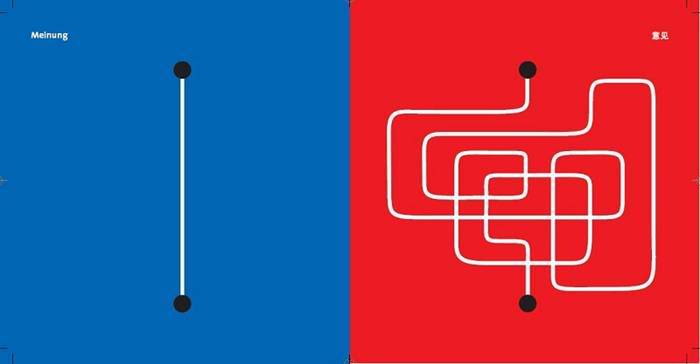
This mail is doing its customary rounds on the net, and not for a wrong reason! Though there are obvious pitfalls of stereotyping people, it also serves as a handy learning guide, even a field manual, when the similarities are generic in nature, and far outweigh the minute differences that might make an individual unique and different from others, but not dramatically different from other fellow tribesmen. The fact is we are all different, and success at workplace is also impacted by our ability to recognize, appreciate, respect and work through such cross-cultural differences. In today’s increasingly globalized world, this serves as a good starting point to recognize that there are people different from us, and a team’s success is impacted by mutual understanding of such differences. These icons were designed by Liu Young who was born in China and educated in...
How are Ethics and Excellence related ?
A friend sent a nice story: A gentleman was once visiting a temple under construction. In the temple premises, he saw a sculptor making an idol of God. Suddenly he saw, just a few meters away, another identical idol was lying. Surprised, he asked the sculptor, “Do you need two statutes of the same idol?”. “No”, said the sculptor, “We need only one, but the first one got damaged at the last stage”. The gentleman examined the sculpture. No apparent damage was visible. “Where is the damage?” asked the gentleman. “There is a scratch on the nose of the idol” replied the sculptor. “Where are you going to keep the idol?” asked the Gentleman. The sculptor replied that it will be installed on a pillar 20 feet high. “When the idol will be 20 feet away from the eyes...