So, does agile really kill innovation?

In continuation of my earlier blog post on ‘Does Agile Kill Innovation?’, I had a great time moderating the panel discussion at Agile India 2013 with Henrik Kniberg, Owen Rogers, Sujatha Balakrishnan, Udayan Banerjee, Praful Pillay and Sudipta Lahiri. The panel discussion was literally the last program at the end of two long days of management conference – but despite that, we had 60-70 folks throughout the session.

Agile methods, with their rather short-term focus on achieving a ‘done’ feature seem to give away an impression that the eventual goal of a sprint is delivering such a full-baked feature. However, the new-age thought process seems to be more like ‘done is better than perfect‘. Question is, does agile implicitly become the rate-limiting step for your innovation process by self-imposing a stringent and non-negotiable completion criteria that possibly can’t be met by innovation-led ‘stories’ where the discovery and experimentation is generally a long-haul process and failure is such an acceptable outcome that we want to fail early and fail often!

We had some interesting perspectives ranging from ‘agile kills innovation’ to ‘agile accelerates innovation’ to ‘it depends’. Some of the ideas that emerged out of the panel discussion were: Continue reading

How do you manage intercultural issues in your teams?

I recently had the good fortune to fly in from Doha to Dubai in a Dreamliner, and later again from Bangalore to Delhi – before they got grounded following a safety advisory. No doubt, it is a marvel of engineering excellence, and I am sure they will figure out battery problems sooner than later.

However, while reading this article “From the Start, Dreamliner jet program was doomed”, I could not help express surprise over some of the issues discussed. While some of the issues reflect a very high-end of engineering being tried out for the first time, and hence some teething troubles could be expected that could be solved by engineering, some other relate to the human aspects, surely not happening for the first time, which perhaps trumped several other issues:

It seemed like the Italians only worked three days a week. They were always on vacation. And the Japanese, they worked six days a week,” said Jack Al-Kahwati, a former Boeing structural weight engineer.

Continue reading

Does Agile Kill Innovation?

I will be moderating a panel discussion on this topic at the Agile India 2013. Given the incessant pace of technology evolution, ever-growing competition where product functionality is hardly the differentiator anymore (if it ever was!), shrinking time-to-market expectations where ‘continuous deployment‘ seems to have been relegated to a hygiene factor already, there are clearly two major trends in product development. While development teams are focusing on using principles from agile, lean, kanban and lean startup to tackle risks and uncertainties earlier in the lifecycle and deliver working software to improve customer collaboration from the word go, the business are looking at complex world, more popularly known as the ‘VUCA’ world - Volatile, Complex, Uncertain and Ambiguous, where making big bets seems fraught with risks of untold magnitude (not to mention, the additional pressures of quarterly earnings calls, at least for public companies), and ironically, the other option of incremental innovation seems to be simply not a fit candidate for the ‘next big thing’.


Agile India 2013So, is agile just that much - a set of powerful methods to simply improve the development efficiency without being able to answer the fundamental questions from the business that funds it and expects to get a topline ROI? Or, should the businesses start looking out at next big thing on their own? Are ‘agile’ and ‘innovation’ the long-lost cousins who are destined to meet somewhere sometime, or are they at a fundamental conflict with each other, and we have simply created a new two-axis ‘project triangle‘ - where you could choose just one of these two?

Agile practices are sometimes considered an ‘overhead’ by product teams that are used to a more free-wheeling culture of innovation, and sometimes considered too ‘lightweight’ for developing large enterprise-class products that require high availability or reliability requirements to be rigorously baked into the product. Similarly, for companies that manage outsourced application development and product maintenance work, the notion of delivery reliability and predictability is paramount from their customer’s perspective, and hence leaves little scope for innovating service delivery processes. On the other hand, we do have examples of application of agile, lean and lean startup practices leading to highly successful innovation, especially in web-based startups.

Continue reading

How are you managing your talent?

In recent times, performance appraisal has been a subject of intense ideological debates. Performance appraisals have traditionally served as a mechanism to basically assess an individual’s performance in the previous year to reward employees in terms of compensation and career progression in the coming year. On one hand, organizations, at least the reasonably larger ones, need some systematic and transparent way to deal with employee’s performance evaluation. On the other hand, with more part-time and virtual employees entering the workforce on a very mission-based engagement as opposed to building a long-term career, the whole idea of formal performance management systems seems to be rather backdated. So, what’s the real deal?

The discipline of performance management has been relatively recent, and rather controversial. Taylor pioneered the subject with his famous Time and Motion studies that highlighted the notion of individual worker productivity, and demonstrated, rather successfully, how application of scientific management could be used to tremendously improve such productivity without exhausting or shortchanging the worker. His thoughts on The Principles of Scientific Management are a great peek into the social system and division of responsibilities between management and workers at American workplace at that time, and should be considered as just that – a journey in time where human society was coming together for the very first time to engage in large-scale machine-based manufacturing, and the theories and practices were still very raw and constantly evolving.

talentHe criticized that the ‘best system’ at that time, the so-called ‘initiative and incentive’ management was really not the best because it relied completely on the workman, and, in turn, made management unconditionally responsible for this. His fourth principle states – “There is an almost equal division of the work and the responsibility between the management and the workmen. The management take over all work for which they are better fitted than the workmen, while in the past almost all of the work and the greater part of the responsibility were thrown upon the men”. He further writes – “It is this combination of the initiative of the workmen, coupled with the new types of work done by the management, that makes scientific management so much more efficient than the old plan”. While I believe Taylor’s intent must have been to apportion the accountability to the one best-suited to influence and ultimately achieve the results, thereby protecting the innocent workers for collective outputs beyond their scope of control or influence, I think this has also led to some serious long-term challenges. However, in an unfortunate way, in one sweeping shot, Taylor condemned an entire generation of workers to subservience by keeping them outside the decision-making process, which subsequently rose on to become an elite preserve of the new management class. This further championed the era of Fordism where ‘division of labor’ and moving assembly line lead to unprecedented growth in productivity, faster production times and worker wages, but also led to lower skill requirement from the workers. Here’s an interesting piece on this counterintuitive thinking from Henry Ford and Innovation, which was a marvel at that time, and literally led to creation of an America middle class and a culture of mass consumption: Continue reading

Calm down Sandy! Calm down!!

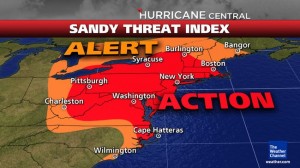
Sandy continues to unleash its raw fury tonight.

Over 14,000 flights had been cancelled ahead of the landfall. Once it crashed ashore, it brought calamity of unknown proportions. 10,000 calls were being received every half hour in NYC to 911. The subway seems to be submerged 4 feet under water, and there are conflicting reports of 3 feet of water on the floor of NYSE. Millions of homes are without electricity. Cars are floating on streets and the high tide only made the situation worse (water since then seems to be receding in NYC). There is a snapped crane dangerously hanging and swinging at 90-storey skyscraper and no one can do anything about it. JFK Airport is closed due to flooding. Seawater has entered close to a mile in Atlantic City.

Ten more states are bracing for the worst natural disaster of our times.

Continue reading

Are you thinking about solving the problem, or simply fixing it?

What is the first thing that comes to mind when we see the problem? Most of us immediately jump in to start solving it. While this might appear to be a natural instinct and a logical choice for some simple problems, reality could often be otherwise, especially for complex problems. If we don’t know enough about genesis of that problem, we might spend countless hours ‘fixing’ it, and yet hardly make any meaningful headway. Or, we might fix it in the short-term, but might not solve it in the long-run, i.e. address the root-cause behind it. For all we know, the first thing we do might actually be the worst!

“If I had an hour to solve a problem, I’d spend 55 minutes thinking about the problem and 5 minutes thinking about the solutions” – Einstein

There is an interesting story about the famous Jefferson Memorial. A few years back, for no apparent reason, the monument was found decaying significantly more than other monuments. At the initial inspection, it seemed like it was acid rain or some such thing, but on detailed inspection, and after asking a series of ‘why’ questions, the root-cause was found to be completely unrelated to the original problem. Here’s roughly how the chain of thoughts proceeded:

Continue reading

What’s in a Name?

[Note: This article was published in PM Network Sep 2012 “Peer to Peer” column as a dialogue between me and Cindy Lee Weber, PMP, a practice manager at Trissential in Minneapolis, Minnesota, USA. Registered PMI Members can access the magazine and the article here. My article is reprinted here, and my views are in green color.]

Tathagat Varma, PMP: Fewer people confuse projects and programs than they did 10 years ago, but there still is some confusion because it can be objective. By definition, a project is an endeavor funded by finite resources with a finite duration and specific outcome. A program is a group of projects aligned by a single objective or outcome that can be better managed collectively than individually.

Cindy Lee Weber, PMP: There also can be confusion in projects versus work effort. For example, a request for a report that will take less than 200 hours and US$ 1,000 might be deemed an operational work effort rather than a project. You might not use the same project management framework, or you might use the same framework but with less rigor.

Continue reading

Can Program Managers Make it to the Executive Suite?

Note: I recently shared some view on this subject for PMI’s Career Central article by the same name. You can access the original article here. In this post, I have shared the original article, with my comments highlighted in green color.

  Continue reading

What’s the People factor in your Innovation equation?

Innovation is the hot new buzzword of our time. Everyone seems to be badly smitten by it. Going by the popular literature, those who don’t innovate are assured to perish sooner than later. Given that previous silver bullets Total Quality Management of 80s, Business Process Reengineering of 90s, and the most recent of them all – Outsourcing in early 21st century – have still left a LOT to be desired, there is clearly enough interest and expectation if Innovation can finally deliver! Coupled with a world still edgy after major Global Financial Crisis and an uncertain Euro zone, and we have perfect conditions to embrace Innovation in all shapes and forms – right from black magic to a holistic way of doing business – even if it still turns out to be a whimper.

Wait! Of course, it would be blasphemy to even as much as suggest that innovation could turn out to be a whimper! Like all of you good people, I too believe innovation is the key to sustainable competitive advantage in the increasingly uncertain and hyper-dynamic world. But, let’s just rollback to 80s for a moment – didn’t they say the same about TQM in those good old days? Or about BPR in 90s? Or about outsourcing until the last decade? Each generation came up with its own silver bullet fervently believing in its potent powers to slay the demons of poor corporate performance (in whatever metrics what you measure – be it topline revenue, or bottomline profits, or marketshare, or employee engagement and so on). And yet, history – the roughest of them all teachers – has reminded us time and again how naïve and wrong we were all along! All these management systems – well thought out and backed by years of irrefutable research and solid data – were heralded as the ultimate panacea in their heydays. However, they lasted only till the next crisis! The next sets of crises were much more powerful, much bigger and more ‘new’ than the previous ones, and like the stains of bacteria that grow resistant with each new antibiotics, they were invincible with the then start of art methods. Clearly something was amiss.

Here’s my take – all these systems were exactly that – just systems! They sought to fix the processes without really putting people in the middle of the equation – even though all the work was carried out by humans. I think we took Frederick Winslow Taylor a tad too seriously when he said, “in the past, the man has been first; in the future, the system must be first” in The Principles of Scientific Management back in 1911. Of course, we forgot to read the next two lines right after this sentence, “This in no sense, however, implies that great men are not needed. On the contrary, the first object of any good system must be that of developing first-class men; and under systemic management the best man rises to the top more certainly and more rapidly than ever before”. We simply delinked people from process and attacked the process performance problem without acknowledging that if people are not motivated enough, the performance improvement payoffs might either be short-lived and might not sustain at the same levels in the long run.

Continue reading

Effective Escalation Practices

This article was provided by Erin Palmer from the University Alliance. Erin writes about project management topics such as PMP certification.

Great leaders know how to focus on project management competencies. Perhaps nowhere in project management do effective soft skills shine through more than in the process of escalation and escalation mitigation. Knowing when and how to escalate requires more than just an intimate knowledge of the emerging issue, but a deeper understanding of the entire business landscape surrounding the events that have led you to this moment. Handling conflict in an action-oriented manner that effectively brings about resolution and promotes team cohesion may at first seem like contradictory goals. On the contrary, effective project managers know that teams work best when trust in leadership is palpable and when team members feel confident that if a problem arises, the leader will expediently and effectively resolve the issue. Strong leaders have strong teams and that is why it is imperative to spend time considering the finer points of an escalation strategy as part of your overall professional development process.

The Art of Knowing When to Escalate

Continue reading

Proudly powered by WordPress
Theme: Esquire by Matthew Buchanan.

%d bloggers like this: